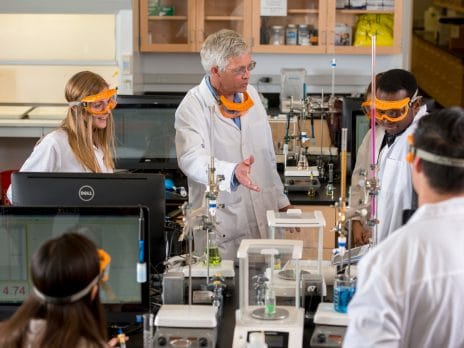
Research centers and institutes
More than 30
university-funded research institutes and centers give faculty and students the
opportunity to:
- shape
public policy
- provide
research that impacts our environment and our communities
- contribute
to the economic development within our state
Amino Acid Geochronology Laboratory
The AAGL is dedicated to
estimating the ages of Quaternary (< 2 million years old) deposits by
analyzing the extent of racemization of amino acids preserved within carbonate
fossils. The lab uses both conventional ion-exchange and reverse-phase ion
exchange liquid chromatographs for separating and detecting amino acids. The
lab is supported in part as a shared facility by the National Science
Foundation.
AzTrans: The Arizona
Center for Applied Transportation Research
Spearheading transportation
research projects that implement alternative ways for municipalities to more
efficiently measure traffic flow, utilizing the latest automated technology.
Center for Microbial Genetics & Genomics
MGGen carries out research
on dangerous pathogens, such as anthrax, plague and tularemia, which are
important to biodefense and initiate new research efforts in environmental
genetics and genomics as they relate to infectious diseases and ecosystem
health.
Center for Applied
Research and Environmental Endocrinology (CAREE)
For more information, please
call: 928-523-4979
Colorado
Plateau Biodiversity Center
The CPBC cares for more
than 400,000 specimens in seven divisions of life sciences
collections. These collections support research and education in:
- ecology
- evolution
- conservation with
special emphases in
- paleontology
- quaternary
climate change
- botany
- entomology
- marine
invertebrates
- fish
- reptiles
- amphibians
- birds
- mammals
- fungi
- DNA
bioinformatics
Colorado Plateau Cooperative Ecosystem Studies Unit (CPCESU)
The Colorado Plateau
Cooperative Ecosystem Studies Unit (CPCESU) is a cooperative network,
transcending political and institutional boundaries, which creates innovative
opportunities for research, education, and technical assistance in support of
the management and stewardship by partner agencies of the Colorado Plateau's
natural, cultural, and social resources.
Colorado Plateau Research Station (CPRS)
The Colorado Plateau
Research Station is a joint USGS and NAU biological research organization. Its
mission is to provide high-quality, objective science to support sound
management of natural resources, with a focus on Department of Interior lands.
Major areas of research include:
- ecoregional
studies
- climate
change
- endangered
species
- vegetation
distribution
- ecology
and dynamics
- data
management and dissemination
- inventory
and monitoring studies
- cave
ecosystems
- wildlife
ecology
Electron Microscope Facility
The Imaging and Histology
Core Facility provides imaging services to faculty, undergraduate and graduate
students, along with our industry partners. This is accomplished through
excellence in education, research, mentoring, and technology.
Environmental Genetics & Genomics Facility (EnGGen)
The Environmental Genetics
and Genomics Facility is a multi-user research laboratory designed for diverse
biological applications. This high-throughput laboratory is a regional resource
center that supports molecular genetic analyses and training across a wide user
base including regional academic, government and private institutions.
Imaging and Histology Core Facility
The facility consists of:
- a
transmission electron microscope (JEOL 1200EX II)
- a
scanning electron microscope (LEO 425VP)
- a
McBain Instruments Confocal Microscope
- numerous
ancillary equipment for specimen fixation and preparation, including
cryopreparations
Institute for Sustainable Energy Solutions (ISES)
The Institute for Sustainable
Energy Solutions (ISES) provides society with broadly educated energy experts
and new technologies, and helps shape energy decision-making in both the
private and public sectors while increasing the public's energy literacy.
Energy is closely linked to economic prosperity, quality of living, air and
environmental quality, human health, and water consumption especially in the
arid regions. ISES advances renewable
energy, energy efficiency, and energy utilization (e.g. smart grid, innovative
energy systems, etc.) research and education initiatives at the university, in
partnership with research centers statewide and nationally, and via a range of
external partners, adhering to a "triple bottom line" of social,
economic, and environmental sustainability.
- Wind: ISES is a regional and national leader in
wind energy research, with projects that reach internationally.
- Solar: ISES performs research in grid integration
and interconnection of solar electricity, as well as solar thermal and
residential solar systems.
- Synthetic
Fuels: The Arizona Synthetic Fuels
Project aims to capture and recycle carbon dioxide from the atmosphere while
harnessing the power of renewable electricity in order to produce a
carbon-neutral liquid fuel that is fully compatible with our existing gasoline
infrastructure.
- Energy
utilization: Energy utilization
encompasses all of ISES’ Energy Efficiency, Demand Side Management, Smart Grid,
or Energy End Use research programs.
- Geothermal: In the area of Geothermal energy we research
the best ways to make electricity and supplemental heat sources for homes and
business.
Institute for Tribal Environmental Professionals (ITEP)
ITEP was created to act as
a catalyst among tribal governments, research and technical resources at the
university various federal, state and local governments, and the private
sector, in support of environmental protection of Native American natural
resources.
Merriam-Powell Center for Environmental Research (MPCER)
The Center promotes
interdisciplinary, environmental research centered on the Colorado Plateau. We
foster collaborations among scientists, land-managers, and educators from
public and private sectors to:
1) understand the basic
ecological principles and major environmental factors, including human
influences that impact ecosystems throughout the globe
2) apply scientific
knowledge for the development of effective strategies that will maintain intact
ecosystems and restore degraded and altered environments
National
Institute for Climate Change Research (NICCR)
The Western Regional Center
of the National Institute for Climatic Change Research (NICCR) is one of four
regional Centers sponsored by the U.S. Department of Energy's Office of
Biological and Environmental Research. The WRC/NICCR facilitates climatic
change research in the western United States through the periodic solicitation
of proposals for research projects to be funded by DOE.
Native American Cancer Research
Partnership
The partnership’s premise
is that a sustainable solution to cancer disparities among Native Americans
must be rooted in the communities.
Sedimentary Records of EnvironmentalChange Laboratory
The laboratory analyzes
physical, biological and isotopic properties of sediment to interpret past
environmental and climate changes. The laboratory specializes in analyzing
sedimentary biogenic-silica content, particle-size distribution, and magnetic
susceptibility. Laboratory personnel have expertise in taxonomic
identifications of freshwater ostracodes.
Teaching and Research Machine Shop
With more than 3,000 projects completed in 20 years, the CEFNS Teaching & Research Machine Shop is the place to bring your ideas for research, lab, or field-oriented equipment fabrication. The shop provides design consultation and fabrication using a variety of materials and machining services, including milling, grinding, welding, lathe work, and cutting of all types of materials. Materials include wood, plastics, steel, stainless steel, aluminum, and brass.
Wireless
Networks Research Laboratory
The Wireless Laboratory is involved in research on
human-cyber-physical systems with a focus on wireless sensor networks for
environmental and ecosystems monitoring.